 .
.
 denotes the set of permissible input arguments.
 denotes the set of permissible output arguments.
 denotes the logical constraint (
 or
or
 )
on the mandatory input arguments.
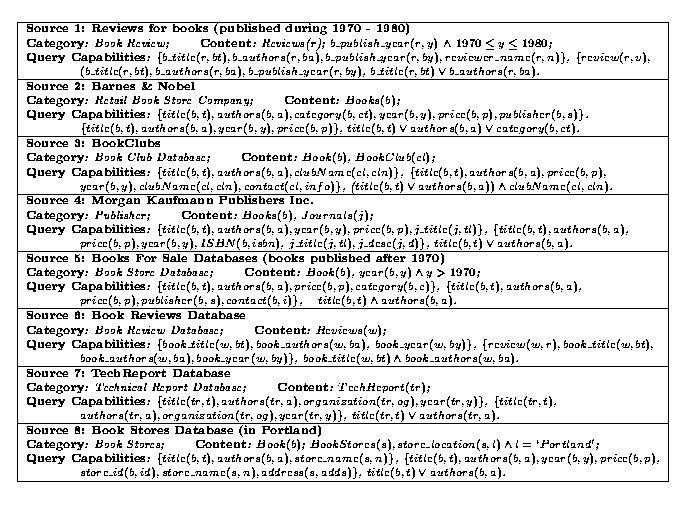
Figure 3 shows the set of content records and
the set of capability records
of the information sources listed in Figure 1.
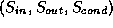
From now on, we denote each information source by a triplet
)
on the mandatory input arguments.
Figure 3 shows the set of content records and
the set of capability records
of the information sources listed in Figure 1.
From now on, we denote each information source by a triplet
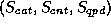 where
where
 denotes the text description of the category of the source,
is a set of source relations, each may be
associated with some access constraints,
i.e.,
denotes the text description of the category of the source,
is a set of source relations, each may be
associated with some access constraints,
i.e.,
 ,
,
 denotes a set of query capability descriptions,
each of the form
.
denotes a set of query capability descriptions,
each of the form
.
Example 2
Consider Source 5 in Figure 3.
 = Book Store Database,

 ,
,
where
 ,
,
 ,
,
 .
.
From now on, we assume that for each information source registered, we will have its source content and capability profile created. Once queries are posed to the global information system, for each posed query, a virtual interface schema and a user query profile will be created to capture the structural and semantic context of the query and to receive its answer.
In the subsequent sections we describe the role of metadata profiles captured for the user queries and for the data sources in query routing, a first step in distributed query processing.