 The NAVE was designed as a prototype for a system that will be part of
a cultural exhibit in Santiago de Compostela, Spain. The NAVE is built
on a 16x12 foot platform, raised 18 inches off the floor. The floor was
raised to simplify the wiring of equipment under the platform, as well
as to accommodate the Aura bass
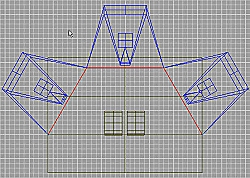
shakers mounted underneath. Because of space restrictions, the projection
was accomplished using folded optics as seen in the blueprint image.
The NAVE was designed as a prototype for a system that will be part of
a cultural exhibit in Santiago de Compostela, Spain. The NAVE is built
on a 16x12 foot platform, raised 18 inches off the floor. The floor was
raised to simplify the wiring of equipment under the platform, as well
as to accommodate the Aura bass
shakers mounted underneath. Because of space restrictions, the projection
was accomplished using folded optics as seen in the blueprint image.
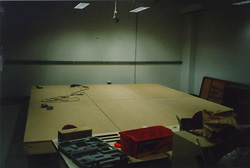 The
platform itself is made up of 6 4x8 foot pieces of particle board mounted
on a secure and sturdy frame. The size of our platform was determined by
the size of our screens (3, 6x8 foot screens) and their alignment (the
two side screens are at a 120 degree angle from the center screen). We
chose to go with this screen configuration as an improvement over the standard
90 degree CAVE configuration. The
platform itself is made up of 6 4x8 foot pieces of particle board mounted
on a secure and sturdy frame. The size of our platform was determined by
the size of our screens (3, 6x8 foot screens) and their alignment (the
two side screens are at a 120 degree angle from the center screen). We
chose to go with this screen configuration as an improvement over the standard
90 degree CAVE configuration.
 With
a greater angle between the screen, the sharp shadows often associated
with screen seams in CAVE's are diminished. Ideally, the viewing surface
would resemble a sphere, where the visual disparity between different parts
of the screen is close to zero. Our design is a compromise using 3 screens
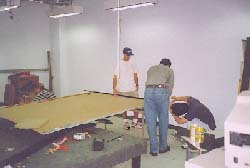
and gives the user a field of view of 180 degrees (horizontal). Here we
are seen trimming one of the screens to the right size. With
a greater angle between the screen, the sharp shadows often associated
with screen seams in CAVE's are diminished. Ideally, the viewing surface
would resemble a sphere, where the visual disparity between different parts
of the screen is close to zero. Our design is a compromise using 3 screens
and gives the user a field of view of 180 degrees (horizontal). Here we
are seen trimming one of the screens to the right size.
 Out
of consideration for our application as well as budget we chose to go with
a passive stereo system. The VRex projectors
that we use (VR2210) use a polarized light system for delivering stereo
images. This is a very cost effective and sturdy solution. The projector
polarizes every other scanline differently, and the user wears what appears
to be a standard set of sunglasses to see the stereo images. This means
that there is no expensive or fragile equipment in the user´s possession. Out
of consideration for our application as well as budget we chose to go with
a passive stereo system. The VRex projectors
that we use (VR2210) use a polarized light system for delivering stereo
images. This is a very cost effective and sturdy solution. The projector
polarizes every other scanline differently, and the user wears what appears
to be a standard set of sunglasses to see the stereo images. This means
that there is no expensive or fragile equipment in the user´s possession.
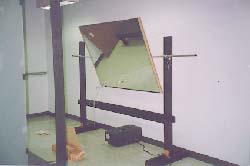 Because
of our polarized light solution we had to use special, polarity preserving
screen material. Due to space limitations we utilized two mirrors in order
to fold the optics and produce the desired effect. Despite this fact, the
NAVE occupies a 20x24 foot space. The mirrors were bought from a local
mirror supplier, and they do not affect the polarization. Mylar mirrors
were suggested. Though much lighter they proved to be expensive and
difficult to find. Because
of our polarized light solution we had to use special, polarity preserving
screen material. Due to space limitations we utilized two mirrors in order
to fold the optics and produce the desired effect. Despite this fact, the
NAVE occupies a 20x24 foot space. The mirrors were bought from a local
mirror supplier, and they do not affect the polarization. Mylar mirrors
were suggested. Though much lighter they proved to be expensive and
difficult to find.
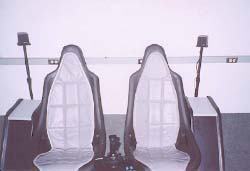 The
first NAVE was designed as a seated environment for two people. The user
is seated in a Thunderseat with a sub-woofer mounted underneath for audio
effects. The stereo view and spatial audio system is focused at the seat
location for maximum impact. The user interacts by using a force-feedback
joystick to navigate the environment. The
first NAVE was designed as a seated environment for two people. The user
is seated in a Thunderseat with a sub-woofer mounted underneath for audio
effects. The stereo view and spatial audio system is focused at the seat
location for maximum impact. The user interacts by using a force-feedback
joystick to navigate the environment.
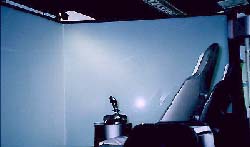 Our experience has shown that audio and other sensory information can provide
powerful immersion cues. We chose to emphasize these cues in the
NAVE. Our experiments have indicated that simple graphics is sufficient
to establish a sense of immersion if latency is low and audio
cues are present.
Our experience has shown that audio and other sensory information can provide
powerful immersion cues. We chose to emphasize these cues in the
NAVE. Our experiments have indicated that simple graphics is sufficient
to establish a sense of immersion if latency is low and audio
cues are present.
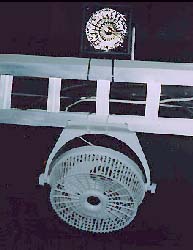 In order to strengthen the sense of immersion we are employing a few tricks
and special effects. Part of the Santiago 2000
experience includes a virtual thunderstorm. As the users walk through
the rain, the fans cool their skin, which matches their expectations of
what should happen. A strobe-light generates artificial lightning,
the thunder of which can be felt through the platform and the thunderseats.
Among our list of improvements which we are currently implementing is the
automation of the fans and strobe light, additional audio effects, and
the development of realistic force-feedback control.
In order to strengthen the sense of immersion we are employing a few tricks
and special effects. Part of the Santiago 2000
experience includes a virtual thunderstorm. As the users walk through
the rain, the fans cool their skin, which matches their expectations of
what should happen. A strobe-light generates artificial lightning,
the thunder of which can be felt through the platform and the thunderseats.
Among our list of improvements which we are currently implementing is the
automation of the fans and strobe light, additional audio effects, and
the development of realistic force-feedback control.
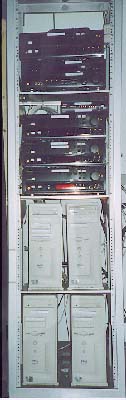 Behind the screens of the NAVE you will find a sophisticated audio setup,
and 4 IBM compatible PC's. It is our opinion that a PC based platform is
an attractive solution due to its rapid and continuous hardware improvements
driven in part by the game industry. We have found that for many purposes,
an off-the-shelf $2000 PC will outperform an SGI. Our switch to a PC based
platform has been influenced by the PC's audio capabilities and the ease
of development afforded by DirectX.
Behind the screens of the NAVE you will find a sophisticated audio setup,
and 4 IBM compatible PC's. It is our opinion that a PC based platform is
an attractive solution due to its rapid and continuous hardware improvements
driven in part by the game industry. We have found that for many purposes,
an off-the-shelf $2000 PC will outperform an SGI. Our switch to a PC based
platform has been influenced by the PC's audio capabilities and the ease
of development afforded by DirectX.
Our NAVE uses a PII 450MHz PC with a SoundBlaster
LIVE! and a Diamond MX200 soundcard for audio. This PC also acts as the
joystick controller, passing the positional information to the 3 PIII 500MHz
PC's running the 3 projectors. The PIII 500's use NVidia TNT based graphic-cards
to render the virtual world in OpenGL at a resolution of 1024x768. The
stereo is generated by rendering the two eye views in different buffers
and then using the stencil buffer to interlace the two images into the
format required by the projector. The frame-rates attained depend heavily
on the model and use of textures but fall in the range of 15-25 fps in
our application. We are expecting improved results with the new TNT2 based
video cards. The audio signal is sent to 4 Pioneer amplifiers. Two amplifiers
drive the 4 Bose speakers, and two others drive the thunderseats and the
six Aura bass shakers under the
platform.
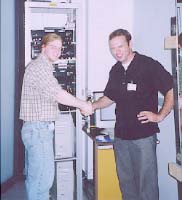 The construction was funded by the Technological
Research Institute of the University of
Santiago de Compostela, Microsoft
and the National Science Foundation. The
entire project cost a total of USD $60,000, including the cost of the projectors,
screens, computers, sound, lumber, and labor. The actual construction was
carried out by a team of 4 students over the length of 4-5 weeks. It is
our estimate that with the right designs, the right equipment, and having
all the parts before starting, this work could be done by a similar team
in half that time. In this picture we see Jeff Wilson and Jarrell
Pair (from left to right) after a successful test of the NAVE.
The construction was funded by the Technological
Research Institute of the University of
Santiago de Compostela, Microsoft
and the National Science Foundation. The
entire project cost a total of USD $60,000, including the cost of the projectors,
screens, computers, sound, lumber, and labor. The actual construction was
carried out by a team of 4 students over the length of 4-5 weeks. It is
our estimate that with the right designs, the right equipment, and having
all the parts before starting, this work could be done by a similar team
in half that time. In this picture we see Jeff Wilson and Jarrell
Pair (from left to right) after a successful test of the NAVE.
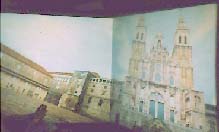 We feel that with the NAVE we have shown that wide angle immersive displays
can be built affordably for widespread use in academic and professional
environments. We expect to extensively use the NAVE in our future VR work.
We are currently adapting our existing environments for NAVE use.
We feel that with the NAVE we have shown that wide angle immersive displays
can be built affordably for widespread use in academic and professional
environments. We expect to extensively use the NAVE in our future VR work.
We are currently adapting our existing environments for NAVE use.
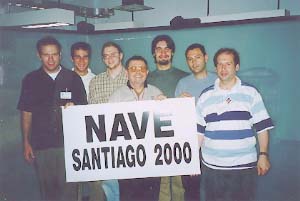
The NAVE/Santiago 2000 Team,
(Pictured Left to Right)
Jarrell Pair, Dave Gotz, Jeff Wilson,
Larry Hodges,
Carlos Jensen, Julian Flores, Juan Arias
|