The inaugural project for the
NAVE is Santiago
2000, a collaborative effort between Georgia
Tech's Virtual Environments Group and the Technological
Research Institute of the University of
Santiago de Compostela. Santiago de Compostela (Spain) has since the
early middle-ages been one of the first, and most important pilgrimage
sites for the Christian world. It is said to house the remains of the Apostle
Saint James, brought from Palestine after his death in 42 A.D. Since 1120
A.D., Santiago has enjoyed special privilege, first granted by Pope Calixto
II in a Papal Bull (Registerna). On the years where the day of Saint James
(July 25th) falls on a Sunday, those who visit the Cathedral will be granted
the same graces as those attained in Rome. The millenium´s final
Xacobean
year occurs in 1999. Santiago has additional reason to celebrate, as it
has been chosen to be one of nine cultural
capitals of the European Union for the year 2000.
To celebrate these two events, along with
the general euphoria of the new millennium, the Santiago
2000 Project will produce a virtual environment that recreates the
Plaza de Obradoiros in Santiago in addition to several other areas surrounding
this main plaza. The environment will include detailed visual models of
the squares. Furthermore, visitors will hear the church bells, bagpipes,
conversations and singing troubadours as they stroll through the city.
Santiago
2000 demonstrates that a PC-based system can support real-time, high
quality, large-screen, stereoscopic imagery.
Images from Santiago 2000
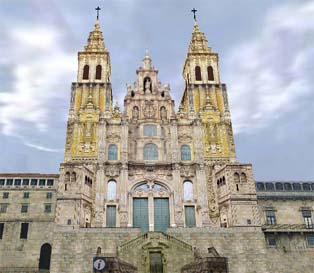
Catedral del Apostol
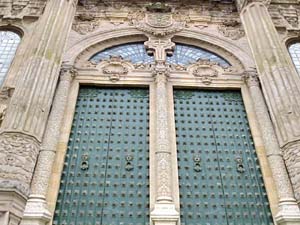
Entrance to the Cathedral
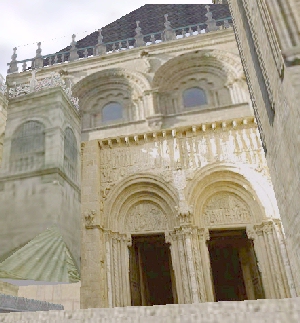
The Benedictine Monasterio
de San Martino Pinario
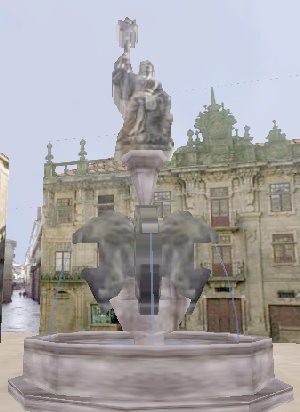
Praza Das Praterias
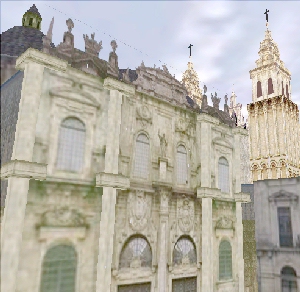
Praza de Inmaculada