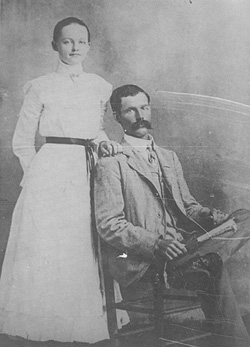
by D. Earl Hightower, DVM
Forward
My attempt to document some of the activities of the Windham household comes from the fact that I was born in Papa and Mama Windham's house on August 15, 1926 at 8AM. The day was Sunday, as I recall being told.
I grew up in Papa and Mama's home until I was about nine years old. Many events come to mind, but only a few can be included here. Some are funny, some sad. The mixture shows that we were like other families in Taylor County, Georgia. Sometimes we wer e good, sometimes we were bad, so it hardly behooves any of us to talk about the rest of us. That is, unless we do it respectfully. The events I write about. I do so with respect and love for all parties herein named.
Dedication
This booklet is dedicated to all the descendants of George Layfette and Will Kimble Windham, and especially to my grandsons, Peter Worth Johnston and Jason Alexander Hightower.
The kitchen floor was about eight inches lower than the "fireplace" room, as it was called. The difference in the levels of the kitchen and fireplace room caused Mama to get a sprained ankle. She was churning beside the fireplace and when the butter had risen to the top of the buttermilk, she picked up the churn and started to the kitchen. After about two steps, she put her foot in my steel dump truck and went riding into the kitchen. The resulting fall spilled milk and butter all in Mama's hair and g ave her a sprained ankle. For about a week she sat with her ankle in a clay poultice and elevated. I was very sorry and repentant and felt if was my fault. Mama never said a word of blame to me.
The "fireplace" room held Papa and Mama's feather tick bed. In the early spring, my heels and heel strings would be chapped and cracked. Mother made me wash my feet every night after going barefooted all day. I would sit in the doorway and cry because my feet hurt when washed. Mother would take pity on me at times and soak the dirt off in warm water and gently soap and clean my feet. Afterward she greased them with some ointment. It may have been carbolated vaseline, Cloverine Salve or just plain ho g lard, I really don't know. She then put clean socks on me and I would climb into bed with Papa. The luxury of that feather bed and pillows and the rapidity with which I fell asleep are memories that have stayed with me. Mother later took me to my own bed without my ever waking up.
Under that feather bed was where Papa always kept a few choice watermelons where they would be boh cool and handy. About eleven-thirty on days when lots of children were around, Papa would bring out a big watermelon and cut it, just in time to spoil the children's appetite. It really didn't seem to matter because we always ate at the "second table", anyway.
Papa was always glad to have a crowd at his house. When he went to church, he'd always invite the preacher home. Rev. Paul Mosley and his wife ate many a meal at Papa and Mama's house, as did his brother and many other preachers. When you drove up to P apa's house, his standard salutation was "Light and come in!"
Whenever Papa was goin to ride in a car, he was always the last person to get in and then usually got on the running board as the car started to move off. I guess he figured there was no need to get in if you couldn't get it started.
The only bad habit that Papa and Mama had was tobacco. Papa chewed Apple Sun Cured chewing tobacco which he bought by the little square wooden box. He kept them under his bed, also. He always put a small chew in his jaw most of the time during the day when he wasn't eating or drinking water. Mama dipped snuff. A blackgum twig provided a perfect applicator for the snuff. We all saw to it that Mama had plenty of tooth brushes. She was very discreet in her use of snuff. She didn't hide it, nor did sh e flaunt her habit, either.
All of Mama's cooking was from scratch. I don' ever recall seeing her use a recipe, although she may have. Her biscuits were always good, hand rolled out and had good tops and bottoms. They were just right to punch a hole in with your finger and gradua lly fill with cane syrup until it was heavy as lead. Mama's cold sweet potatoes were always sweet and filling. Peach puffs were a real treat when she had time to make them. Her tea cakes were decorated with fork tine marks and never needed raisins or p ecans to make them edible. They were always delicious. Her blackberry and peach pies never went begging, either. Mama never had to pick berries or peaches. Everyone was only too glad to see that there was always some available when she needed them. S he canned large quantities of blackberries and peaches for winter eating.
Mama liked to fish and she was very good at it. She was a cane pole expert. The first thing she did was catch a small bream and set out a "trout" pole to catch a bass or jackfish. I gathered crickets, grasshoppers, catalpa worms or redworms out of the bait bed at the back of the house to take with us. These worms were maintained with coffee grounds, siftings of corn meal and dish water.
I went fishing with Mama every chance I got. We always had a good time. I found a bream bed one time and Mama went with me and we fished it together. We had to wade out to knee deep water. Mama got the bottom of her long dress wet, but she didn't mind. If she did, she never let me know.
Mama gave me an early lesson in courage and bravery. I was about eight years old. It was the last day of school and I was running up the road to tell mama that I had passed. As I called out to her, she signaled to me to be quiet. She was slipping up o n a stray dog which was lying in the front yard. It appeared to be sick. Rabies was a possibility since it was common at that time. Mama had an iron stake in here hands and she killed the dog with one blow. She had the courage to do what had to be don e.
Weather always played a role in the lives in the Windhams. One night after supper a storm came up and some of the "boys" were playing mumble peg with knives. They were playing for matches. Papa was reading the Bible using his store-bought magnifying gl asses. The light of the kerosene lamp flickered in the wind as the storm grew in intensity as it got closer. Papa told the boys that playing for matches was gambling and the Lord would punish them for it. The words were little more than out of his mout h when lightning struck a large cedar tree in the front yard. There were three big cedar trees in the yard, but lightning struck the one nearest the porch. Everyone was severely shocked, J.W. was nearly killed, several were knocked in the yard. Everyon e recovered, but I can tell you that if Papa ever said the Lord will punish you, he was listened to.
Papa had on old bob-tailed red tabby cat that would come in the kitchen where we all ate and would sit up by Papa's chair. Papa had a great deal of trouble chewing meat so he gave most of it to the old tabby cat sitting erect beside the chair. The cat l earned how to get into the smokehouse where salted side meat hung along with rack after rack of dried, stuffed sausage. Old Tabby would climb up the wall, jump over on to the sausage racks and hang on till he could cut down a sizable length of sausage. The next morning Tabby would be so full of sausage that he couldn't get out of the smokehouse and away from the crime scene. Mama told Papa, "George, I want you to get rid of that old tabby cat. He's eating all the sausage." Papa finally agreed to do s o the next time he went to Butler. Sure enough, he put old Tabby in a sack and shut him up in the trunk of the car. He dumped him out on Cat Ridge just on the outskirts of Butler, which was twelve miles from home. I'm sure Papa missed ol Tabby because he never spoke of the deed again. One year later almost to the day, Old Tabby showed back up for breakfast and when Mama went out on the back porch to get some water, in came the cat and went strait to Papa's chair and sat up to be fed. Needless to say , no one ever suggested getting rid of him again. He lived there quite some time, siring lots of bob-tailed crook-tailed kittens.
The mention of the dinner table reminds me of the time Papa had the preacher home for Saturday night supper and he had bought some tough old cow beef in town. Mama hammered with a saucer, but it was still tough. Jake couldn't cut his, so he stuck a fork in his piece and when Papa wasn't looking, took a bite and whacked it off with a knife, Eskimo fashion. All of the rest of the children thought this was a real riot and laughed and giggled. Papa never did catch on to what was going on.
Papa always grew a lot of very fine sweet potatoes and stored them in a potato house half buried in the soul. The house was across the yard from the well. Papa planted a bed of potatoes to provide slips to set out the potato patches. Leonard had a 4-H Club project to grow one acre of sweet potatoes. He worked hard on Saturdays hauling manure to cover his potato ground and make it rich and productive. As soon as the potato slips began to grow Leonard would grab off the plants, sometimes as few as a do zen, and head to his potato patch and set them out. Papa never objected to Leonard getting the first plants. I guess he wanted him to do well. When harvest time came and the potatoes were plowed up, everyone was astonished at the size of Leonard's pota toes and so many of them. As I recall, some were bigger than grapefruit and the whole crop was over a ton in weight. He won the sweet potato prize in Taylor County that year. Papa was a proud of Leonard's success as we were.
One afternoon, I was coming home from school and Papa and Rufus Payne were trying to drive a sow down to the ten acre field and she sulled and laid down beside the road. Papa had a rope tied around one rear leg, but she refused to move. I told Papa, "Wh y don't you give her some baking soda? That's what Mama uses to make the biscuits rise." After years as a practicing veterinarian, I realized that at the age of seven on that day I had given my first animal prescription.
One of the most agonizing decisions I ever saw Papa make occurred on a Sunday afternoon in the hot August weather. Thunderstorms with violent rains were common place. It required about 2,000 bundles of corn fodder to have roughage for his mules through the winter. The fodder was pulled and tied into hands. Five hands made a bundle. It was dried and perfect to put in the barn. Only trouble was, a big storm was coming and it was Sunday. Papa didn't believe in working on Sunday. "Sunday's work prevai leth nothing," he always said. It looked like the fodder would be wet and lost and the winter food supply for the mules would be lost . The boys pressed Papa, "Let's go get it in," they said. Even the boys there courting the girls agreed to help in the ir white Sunday shirts.
Papa walked the floor and look out of the porch at the worsening sky. Finally he broke and said, "All right, let's go." The boys bounded off the porch, hitched the team to the wagon and literally ran through the field gathering the bundles of fodder. A s the last load was being brought in, the rains came down in torrents. There was no time to unload into the barn, so the mules, with the wagon loaded with fodder, ran into the wagon shed. The crop was saved. It was a good feeling and the boys showed it . Even Papa was proud and he didn't feel guilty of violating the Sabbath.
Papa ran for Justice of the Peace against Mr. Bart Amerson. No one at home wanted Papa to run and tried to dissuade him from filing. He got two votes. He new he voted for himself and he always wondered who the other fellow was. Papa never went hunting that I knew of, although his boys were all big hunters. The only thing Papa ever killed were wharf rats, snakes, hawks and hogs. He butchered a lot of hogs, cured the meat and sold and bartered most of it for work on the farm. He somehow felt it was h is responsibility to dispatch the hogs when the time came for the slaughter. The only problem was, he wasn't a very good shot and many times it required a second shot. Everyone dreaded that part, so whenever possible, the "boys" would grab the rifle and do the job for him. In later years I did the chore for him. He always had the final say-so as to the water being exactly the right temperature in the scalding barrel. He didn't want to "set" the hair. I have seen a few hogs shaved because the hair wo uldn't slip. Mama had the say-so when it came to seasoning the sausage. Once Papa added too much red pepper and it nearly burned us up after the stuff sausage was dried. Mama grew, dried and grated her own sage. I think sage is the only thing that gav e country sausage that wonderful distinctive flavor and taste. Papa grew sugarcane and made syrup both for himself and for sale. The first cane I remember was blue ribbon striped cane. It had to be buried in the fall and dug up and planted next spring, a very time consuming way to grow cane. Next came a perennial that sprouted back from the roots. It was a green cane called Kiana. The juice was green and I always thought the syrup was a little green, too. The last variety he grew was POJ. It also came back from the roots for several years. POJ meant Pride of Jamaica, I think.
In syrup making, Papa also had the final say as to when to take the syrup pan off the furnace. Papa never used an evaporator, although many farmers did. An evaporator is a pan with baffles across it. Raw cane juice poured in one end and syrup was tappe d off at the other end. Sometimes the syrup made in evaporators would mold because it wasn't thoroughly cooked. Papa's syrup was never that way. He would pour the syrup out of a skimming pan and when it sheeted as it was poured back into the vat, it wa s ready to take off. Sometimes he waited just a little too long. When this occurred, you couldn't get the syrup out of the cans because it was so stiff. Mama used this thick syrup to make syrup candy, made with roasted peanuts and butter. Today we cal l it peanut brittle. She also made grate tasting syrup pudding.
One of the most painful experiences I ever had at the cane mill happened when I got a yellow jacket in my mouth while drinking fresh crushed cane juice straight from the rollers of the mill. Needless to say, I got stung in the roof of my mouth. I expell ed that yellow jacket with enough force to have launched a small rocket.
Papa always saw to it that the skimmings off the top of the boiling cane juice went to the hogs as soon as they were cool enough. There were always several people who liked or made skimming liquor and who coveted a barrel or two, Papa was dead-set agains t that.
This was the reason he disposed of the skimmings so quickly. Papa's "boys" hid a barrel in a plum thicket and let it ferment till it was about ready and then they gave it to the hogs in the cornfield. Those hogs really liked the skimming beer and got hi gh. Four hundred pound sows were jumping around, squealing and cavorting like young pigs. The "boys" thought it was great fun but Papa took a dim view and failed to see the humor in the affair. Mama thought it was pretty funny, too, as I recall.
Papa always had eight to ten hogs up in a floored pen feeding them a diet of hard corn to harden the fat. This was necessary because the hogs had been running in the peanut fields all fall. Peanut fat is very soft. He had a large log pen down by the po nd. It was a convenient place to get water for the hogs. All drinking water for the people and mules had to be hand drawn from the well in the yard. In the same field Papa kept the milk cows and some goats. The bill goat had unusually large horns and sometimes took a belligerent attitude to trespassers on his turf. Papa was watering the hogs one day. He took a bucket and leaned over the pond to fill the bucket. The billy goat came up behind Papa and the target presented by Papa bending over was too tempting to resist, I guess. Anyway, the goat let Papa have a good lick in his rear. Papa did a flip in the pond and was sitting in the water face to face with the goat. He reached out and grabbed te horns of the billy goat and the goat backed up, pul ling Papa out of the pond. When Papa got back to the house, he called the "boys" and sentenced that billy goat to have his horns removed. Papa had the only dehorned billy goat I remember seeing in the community.
Papa was insistent that the work stock always be fed and watered regularly and before the people ate. If you came in from the field for dinner, you watered and fed the mules before you sat down to the table. There was one time in 1933 when this practice proved to be frustrating. A severe ice storm had developed and everything was covered wit about an inch of ice. (This was the week-end of Uncle J.W. and Aunt Winnie's wedding.) The mules had to be fed and watered and you could not stand up. The boys got washing tubs and sat in them and pulled water to the barn. They used sticks with nails in the ends to propel themselves along. Using this method, the mules were tended to and corn brought back to the house to feed Mama's chickens. Most of the chick ens were under the house. The "boys" threw corn out on the ice and chickens came slipping and sliding from under the house. Watching the chickens flounder about reminded me of the expression "independent as a hod on ice." Had it been a chicken instead of a hog, I know where it came from.
One afternoon, Papa told Donald to water the mules and he delayed starting a little too long. He and Jimmy Lee Corbin, a black boy whose folks were sharecroppers on Papa's farm, were playing marbles in the front yard. Jimmy Lee said that he was about to shoot Donald's shooting taw. Donald said, "Pour it on" and Papa whacked him with a switch and said "I believe I will." Those mules were watered in the fasted time that I can remember.
Papa was a generous and caring person. No hobo, tramp or any other person was ever turned away without food. During the depression of the '3s, lots of wanderers and homeless came by and asked to work for something to eat. Papa always let them chop some kindling or fill the wash tub with water for the mules. This way he left a man with his self respect intact. One man ad slept in the cornfield and had nothing to eat but raw corn for the last two or three meals. He helped in the fields for his feed a nd wound up staying about six months until the crops were in. He slept in the barn. Papa couldn't pay anything because he didn't have any money. The man was very grateful to Papa and became a staunch family friend.
Papa always had "meat, meal and molasses" to help any family put food on the table. He charged very little for the staples, but no one was turned away. Sometimes he required field workers to take part of their pay in the three commodities. It was agree d to before they started to work. No one, that I ever heard of, objected because "Mr. Windham" was always fair.
When Papa was young, he was a very handsome man with a healthy red mustache. One day he cam home with a clean shaven face. His mustache was gone, shaven off. The children thought he looked so different that, according to Mother, they all cried because they were upset at his change in appearance.
George Payne lived up the road on Horse Creek with his son, Rufus. It was always fun to hear George Payne and Papa greet each other. "Hello, George," says Papa. "Hello, George," says Mr. Payne. "Light and come in, George." "Believe I will, George." "George, you been working hard?" "Not too hard, George, you?" "Nope, George," and so it went on and on. They were good neighbors.
One time Papa let me go to the grist mill with him in the buggy. The buggy was pulled by a small, very intelligent mule named "Gypsy." Papa let me hold the lines and pretend I was driving, but Gypsy was driving. A simple command of "Gee" or "Haw" would cause Gypsy to move to the right or left as need be. I felt very important to be going the five miles to the water propelled mill. I remember how the narrow wheels of the buggy cut a rut in the sand and sometimes buried several inches deep in the soft sandy road. The smell of hot, freshly ground corn meal remains with me, yet. The miller was names Slayton and he was very respected in the community. His meal and flour were considered the best around.
Time took its tool and Gypsy became old and lame and Papa traded her to a group of gypsies who made their living trading mules and horses. We all felt bad about Gypsy being gone, but not a voice was raised against Papa's action. Papa got burned on the t rade. The mule he got was never half the mule that Gypsy was. I think Papa always remembered that fact.
I had a dog named Kayo. He was a common fiest with a bob-tail and black and white color. When Mama or Mother started to look for me, they looked for Kayo. Papa was taking a wagon load of cotton to Reynolds to the gin. Kayo followed the wagon and mules . The gin was located beside the railroad tracks. Everything was fine until the train came by. The big, black puffing monster with bell clanging and whistle blowing scared poor Kayo out of his wits. The last time Papa saw him, he was flying down the r ailroad as fast as his legs could carry him. He left in mortal fear for his life. Search as he might, Papa found no sign of Kayo. Convinced that Kayo would catch up, Papa came home. When I found out Kayo was left in town, I pitched a fit. When Aunt Lu ttie came home, I insisted that she go to town and find Kayo. She, Papa and I don't know who else went to Reynolds to find my dog. They found Kayo running up and down the tracks looking for a friendly face. They brought him home and I hugged him and cried.
Mama used to send me up in the field with a jar of fresh water for Jake, who was plowing a team of mules. He was turning the soil getting ready for the spring crops. I would crawl over the terraces and drag the jar of water along. One time the mules st opped suddenly. When Jake looked up ahead, he saw me lying in the furrow asleep with Kayo by my side.
This story is not finished until you know the rest of the story of Kayo, Wonder Dog. He was a rat killer, companion, and was even a hunting dog of sorts. I was still too young to hunt, so I didn't go on the annual Thanksgiving rabbit hunt with the "boys ." A rabbit jumped off a bank onto a sand bed dray wash. Just as one of the "boys" shot the rabbit, Kayo jumped off the bank and caught most of the load of shot. Both Kayo and the rabbit were killed instantly. When I found out about the accident, my g rief was so great that I could not be consoled. Mama fried the rabbit, but no one would eat any of it. Every one was sad. I asked Papa to go over their and give Kayo a proper burial. He did so, taking a shovel and burying Kayo under a large persimmon tree beside a path. I went over later and visited the grave many times. I used to set a rabbit gum there every winter and always remembered Kayo, Wonder Dog, faithful companion.
Mama and Papa Windham raised eight children, five boys and three girls. All were allowed to grow up as separate individuals, sharing few traits in common. They were Eunice, Jack, Eva, Luttie, J.W., Jake, Leonard and Donald, each with their own special t alents. They all had a deep love of the Lord and the respect of their families and friends.
Papa suffered for at least eight or nine years from skin cancer. He endured a lot of pain at a time when cancer was thought of as a plague visited upon the poor victim. He never cursed his affliction and never took any pain medication until his last two days of life. He told J.W. to call the doctor for a shot for pain. He looked at a picture of Jesus and said, "He helped me bear the pain." He died a short time later. Mama came into the room a few minutes later and said simply but truthfully, "He was a good man." I am thankful I was there and heard her.
Mama came to live with Mother, Daddy and me. She was comfortable most of her later life, enjoying reasonably good health. She took great pride in her children and grandchildren. Old age claimed her sight and a stroke claimed her life. The last time I saw Mama, she was blind but her mind was good. She took my hand in her hands and rubbed it and said, "You've got hands like your Papa." Papa had died sixteen years earlier, but she still remembered.
It was quite obvious that Mama'a and Papa's influence on us all was considerable.
No claim is made as to the truth of the events contained in this booklet. It is just the way I remember them.
D. Earl Hightower