APIE Project: Supporting Routine Decision-Making

APIE Project: Supporting Routine Decision-Making |
|
People make hundreds of decisions every day. Rather than optimize those decisions by gathering pertinent information, people instead rely on routines. While those routines are usually sufficient, they do occasionally fail. Those failures present an opportunity to improve decision-making by providing low-cost information when and where people start to follow their routines. We conducted a study to examine the routines that users follow at night and in the morning. Drawing on the results, we created a next-generation alarm clock that highlights unusual situations to help users determine when and how to modify their routines to more effectively decide on an alarm time, what to wear, when to get out of bed, and when to leave for work.
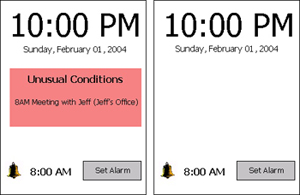 |
Our clock's interface helps users decide the night before when to get up and what to wear by displaying unusual events (left image=unusual, right image=usual). | |
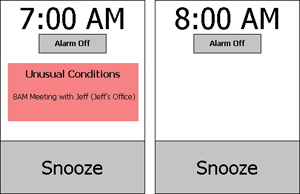 |
While the user's alarm is going off, our clock's interface displays unusual traffic, and weather, and events to help the user decide when to get out of bed. | |
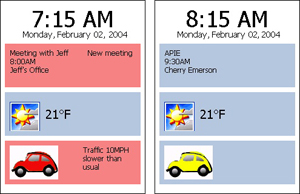 |
After the alarm has gone off, our clock's interface displays unusual event, weather, and traffic information to help the user decide what to wear and when to leave. |
B. Landry, J. Pierce, and C. Isbell. Supporting Routine Decision-Making with a Next-Generation Alarm Clock. In Proceedings of 2AD, 2004. A version of this paper appeared in Personal and Ubiquitous Computing.