Robotic Assistance with Dressing
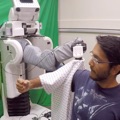
Our research seeks to create mechanical aids for people who have difficulty dressing themselves. The physical task of putting on a shirt or another article of clothing can be difficult or impossible if one has limited movement in an arm or a leg. People who may be in need of such help include older adults, wounded veterans, and people who have suffered a stroke.
It is difficult to appreciate the need for such assistance if you are a fully able-bodied person. To better understand the issues involved, try the following. Imagine that you have lost the ability to use your dominant hand (your right hand if you are a right-handed person). Now, try putting on a shirt without using your dominant hand. Once you have finished this exercise, then try to imagine going through the same task for each of your articles of clothing, every day of your life. As you have probably discovered for yourself, people with limited motion in their limbs sometimes require another person to assist them in putting on their clothing. A person might feel reluctance in asking others to help with such a personal task as putting on clothes. Our research seeks to create a mechanical system for helping people put on clothing, so that they do not require assistance from another person.
We have many mechanical devices in our lives that make our daily physical tasks easier. Our dishwashing machines, coffee makers, automobiles, washers and driers are all mechanical devices that perform physical tasks to make our lives easier. In the future, an even wider variety of devices will be available to assist people in various physical tasks. We envision that one day, help in putting on clothing will be yet another task that can be performed using a mechanical device, for those who are in need of such assistance.
Team Members:
Henry Clever
Charlie Kemp (coPI)
Karen Liu (PI)
Greg Turk (coPI)
Papers:
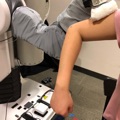
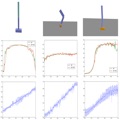
Multidimensional Capacitive Sensing for Robot-Assisted Dressing and Bathing
, Zackory Erickson, Henry M. Clever, Vamsee Gangaram, Greg Turk, C. Karen Liu, and Charles C. Kemp, International Conference on Rehabilitation Robotics (ICORR), 2019.
[arXiv] [Video] [Code]
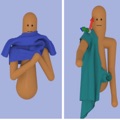
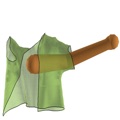
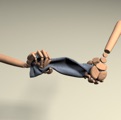
Learning to Dress: Synthesizing Human Dressing Motion via Deep Reinforcement Learning, Alex Clegg, Wenhao Yu, Jie Tan, C. Karen Liu and Greg Turk, in Transactions on Graphics (SIGGRAPH Asia), 2018
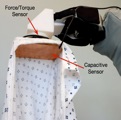
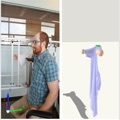
Tracking Human Pose During Robot-Assisted Dressing using Single-Axis Capacitive Proximity Sensing, Zackory Erickson, Maggie Collier, Ariel Kapusta, and Charles C. Kemp, in IEEE Robotics and Automation Letters (RA-L)
[arXiv] [Video]
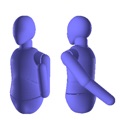
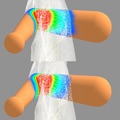
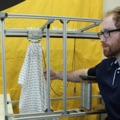
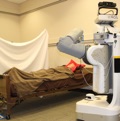
Optimization of Robot Configurations for Assistive Tasks, Ariel Kapusta and Charles C. Kemp, in RSS Workshop on Planning for Human-Robot Interaction: Shared Autonomy and Collaborative Robotics, 2016
[PDF] [Video]
Media Coverage:
https://www.digitaltrends.com/cool-tech/georgia-tech-robot-dress-you/
https://www.cnet.com/news/robot-teaches-itself-to-dress-people-gown-georgia-tech/
https://www.futurity.org/robot-dresses-hospital-patients-1757662/
https://www.sciencedaily.com/releases/2018/05/180514122506.htm
https://interestingengineering.com/this-robot-could-one-day-help-hospital-patients-get-dressed
https://futurism.com/pr2-ai-robot-dressing-gown/
http://zlotonews.com/robot-helps-patients-put-on-hospital-gown-and-other-news/
Sponsors: