CS 4644 / 7643 Deep Learning
Fall 2026, Mon/Wed 3:30 pm - 4:45 pm, Clough 152
Course Information
This is an exciting time to be studying (Deep) Machine Learning, or Representation Learning, or for lack of a better term, simply Deep Learning!
Deep Learning is rapidly emerging as one of the most successful and widely applicable set of techniques across a range of domains (vision, language, speech, reasoning, robotics, AI in general), leading to significant commercial success and exciting new directions that may previously have seemed out of reach.
This course will introduce students to the basics of Neural Networks (NNs) and expose them to some cutting-edge research. It is structured in modules (background, Convolutional NNs, NN Training, Sequence Modeling, Generative Modeling, Frontiers). Modules will be presented via instructor lectures and reinforced with homeworks that teach theoretical and practical aspects. The course will also include a project which will allow students to explore an area of Deep Learning that interests them in more depth.

Teaching Assistants






- Lectures: M/W: 3:30 pm - 4:45 pm, Clough 152
- Canvas (combined section) https://gatech.instructure.com/courses/537336
- Piazza: Access through canvas
- Gradescope: Access through canvas
Class Info & Links
Tentative Schedule (subject to changes)
| Date | Topic | Optional Reading |
| W1: Aug 24 |
Intro lecture + class logistics.
Slides (pdf) HW0 is due 11:59pm 8/28/2026 (NO grace period). See Piazza for instruction. IMPORTANT: All students MUST complete HW0! This is true even if you are currently on the waitlist and want to get in! See FAQ below for instructions. |
|
| W1: Aug 26 |
Machine learning intro, applications (CV, NLP, etc.), parametric models and their components
Slides (PDF) HW0 due 8/28/2026 11:59pm |
|
| W2: Aug 31 |
Supervised Learning, Linear Classification, Loss functions, Gradient Descent
Slides (pdf) HW1 out, due 9/21/2026 11:59pm |
|
| W2: Sep 2 | Backpropagation, Computation Graph Slides (pdf) | |
| W3: Sep 7 | No class: Labor Day | |
| W3: Sep 9 |
Backpropagation with Neural Networks. Optimization Basics
Slides (pdf) |
|
| W4: Sep 14 |
Convolution
Slides (pdf)
Project Proposal out, due 10/7/2026 11:59pm |
|
| W4: Sep 16 |
How to Pick a Project
Slides (pdf) |
|
| W5: Sep 21 | Project Helping Session
HW1 due 9/21/2026 11:59pm HW2 out, due 10/7/2026 11:59pm | |
| W5: Sep 23 |
Convolution, Pooling, Convolutional Neural Networks
|
|
| W6: Sep 28 | Convolutional Neural Networks, Training Neural Networks (part 1): Activation Functions, Data Preprocessing Slides (pdf) | |
| W6: Sep 30 |
Training Neural Networks 2: Weight Initialization, Batch Normalization, Optimization
In-class Quiz 1 - on Assignment 1 materials (NN fundamentals) Slides (pdf) |
|
| W7: Oct 5 | No class: Fall Break | |
| W7: Oct 7 |
Training Neural Networks 3: Regularization and Hyperparameter Search
HW2 due 10/7/2026 11:59pm Project Proposal due 10/7/2026 11:59pm HW3 out, due 10/28/2026 11:59pm Milestone Report out, due 11/04/2026 11:59pm |
|
| W8: Oct 12 |
Learning to Process Sequential Data
|
|
| W8: Oct 14 |
Attention and Transformers
In-class Quiz 2 - on Assignment 2 materials (Convolutional Neural Networks) |
|
| W9: Oct 19 |
Attention and Transformers (continued)
|
|
| W9: Oct 21 |
Natural Language Processing (Remote Guest Lecture)
HW3 due 10/28/2026 11:59pm HW4 out, due 11/16/2026 11:59pm |
|
| W10: Oct 26 | Generative Models: FVBN and VAE
In-class Quiz 3 - on Assignment 3 materials (Transformers) |
|
| W10: Oct 28 |
Generative Models: Diffusion Models
|
|
| W11: Nov 2 |
GANs and Self-Supervised Learning
|
|
| W11: Nov 4 |
Computer Vision: Detection and Segmentation
Milestone Report due 11/04/2026 11:59pm Final Project out, due 12/04/2026 11:59pm |
|
| W12: Nov 9 | No class: instructor traveling | |
| W12: Nov 11 | 3D Computer Vision 1 | |
| W13: Nov 16 |
3D Computer Vision 2
HW4 due 11/16/2026 11:59pm |
|
| W13: Nov 18 |
Large Vision Language Models
In-class Quiz 4 - on Assignment 4 materials (Generative Models) |
|
| W14: Nov 23 | Reinforcement Learning 1: MDP, Value Iteration, Deep Q Learning. | |
| W14: Nov 25 | No Class: Student recess (Thanksgiving Break) | |
| W15: Nov 30 | Reinforcement Learning 2: Actor-Critic, Frontiers. | |
| W15: Dec 2 |
Imitation Learning and Learning from Human Data
Final Project due 12/04/2026 11:59pm |
|
| W16: Dec 7 | No Class (Final Project Video Presentation Due) |
Grading
Grades will consist of the following components:
- 1% Homework 0
- 48% Homework (4 homeworks each worth 12%)
- 15% In-Class Quizzes
- 36% Final Project
- 1% (potential bonus) Class Participation: top endorsed answers/questions/comments on Piazza
We will use a standard grading scheme (A: 90-100, B: 80-90, C: 70-80, D: 60-70, F: < 60)
Late policy for deliverables
- There will be no make-up work provided for missed assignments. Of course, emergencies (illness, family emergencies) will happen. In those instances, please submit an Class Absence Verification Form to Dean of Students office (see here for rules). The Dean of Students is equipped to verify emergencies and pass confirmation on to all your classes. For consistency, we ask all students to do this in the event of an emergency. Do not send any personal/medical information to the instructor or TAs; all such information should go through the Dean of Students.
- Late submission. Late submissions within 48 hours of the deadline will receive a 20% penalty. This will reduce the maximum possible grade to 80% (plus any applicable bonus points). Submissions more than 48 hours late will receive a grade of 0.
In-class Quizzes (15% of course grade)
Over the course of the semester, there will be 4 in-class quizzes (top 3 of which will count), each worth up to 5% of the course grade. For dates, check the updated course schedule above. The quizzes will be administered during the usual lecture time at the usual lecture hall.
These quizzes will be conducted during class time with pen and paper, and may contain multiple choice, computation,
and short answer questions. The topics tested will be based on materials from the lectures and the assignments,
with an emphasis on core concepts, computations, theory and intuitions. Notes, cheatsheets, and other aids are not allowed.
Drop-Policy
The worst quiz grade is dropped. If you are happy with the grade of your first 3 quizzes, the 4th quiz is effectively optional.
If you have missed/will miss a quiz for an institute-approved absence or an excused absence, you may request an additional quiz drop via a private Piazza post, contingent on documentation from the Dean of Students. As an update, you may request a quiz drop retroactively, but only if you have the appropriate documentation from the Dean of Students. Please do not send any personal medical information to us.
Prerequisites
CS 4644/7643 should NOT be your first exposure to machine learning. Ideally, you need:
- Intro-level Machine Learning
- CS 4641 for the undergraduate section and CS 7641/ISYE 6740/CSE 6740 or equivalent for the graduate section.
- Algorithms
- Dynamic programming, basic data structures, complexity (NP-hardness)
- Calculus and Linear Algebra
- positive semi-definiteness, multivariate derivates (be prepared for lots and lots of gradients!)
- Programming
- This is a demanding class in terms of programming skills.
- HWs will involve Python and PyTorch.
- Your library of choice for project.
- Ability to deal with abstract mathematical concepts
Online Student Conduct and (N)etiquette
Communicating appropriately in the online classroom can be challenging. All communication, whether by email, Piazza, Canvas, or otherwise, must be professional and respectful. In order to minimize this challenge, it is important to remember several points of “internet etiquette” that will smooth communication for both students and instructors
- Read first, Write later. Read the ENTIRE set of posts/comments on a discussion board before posting your reply, in order to prevent repeating commentary or asking questions that have already been answered.
- Avoid language that may come across as strong or offensive. Language can be easily misinterpreted in written electronic communication. Review email and discussion board posts BEFORE submitting. Humor and sarcasm may be easily misinterpreted by your reader(s). Try to be as matter of fact and as professional as possible.
- Follow the language rules of the Internet. Do not write using all capital letters, because it will appear as shouting. Also, the use of emoticons can be helpful when used to convey nonverbal feelings. ☺
- Consider the privacy of others. Ask permission prior to giving out a classmate’s email address or other information.
- Keep attachments small. If it is necessary to send pictures, change the size to an acceptable 250kb or less (one free, web-based tool to try is picresize.com).
- No inappropriate material. Do not forward virus warnings, chain letters, jokes, etc. to classmates or instructors. The sharing of pornographic material is forbidden.
NOTE: The instructor reserves the right to remove posts that are not collegial in nature and/or do not meet the Online Student Conduct and Etiquette guidelines listed above.
Plagiarism & Academic Integrity
Georgia Tech aims to cultivate a community based on trust, academic integrity, and honor. Students are expected to act according to the highest ethical standards. All students enrolled at Georgia Tech, and all its campuses, are to perform their academic work according to standards set by faculty members, departments, schools and colleges of the university; and cheating and plagiarism constitute fraudulent misrepresentation for which no credit can be given and for which appropriate sanctions are warranted and will be applied. For information on Georgia Tech’s Academic Honor Code, please visit http://www.catalog.gatech.edu/policies/honor-code/ or http://www.catalog.gatech.edu/rules/18/.
You are encouraged to discuss problems and papers with others as long as this does not involve the copying of code or solutions. After discussions, all materials that are part of a submission should be wholly your own. Do NOT search for code directly implementing the assignment and submit snippets or variations of them. You can search for conceptual information but NOT code solutions. Any public material that you use (open-source software, help from a textbook, or substantial help from a friend, etc.) should be acknowledged explicitly in anything you submit to us. If you have any doubts about whether something is legal or not, please do check with the class Instructor or the TA. We will actively check for cheating, and any act of dishonesty will result in a Fail grade. Any student suspected of cheating or plagiarizing on any deliverable including assignments will be reported to the Office of Student Integrity, who will investigate the incident and identify the appropriate penalty for violations.
Students with Disabilities
If you are a student with learning needs that require special accommodation, contact the Office of Disability Services at 404.894.2563 or http://disabilityservices.gatech.edu/, as soon as possible, to make an appointment to discuss your special needs and to obtain an accommodations letter. Please also e-mail me as soon as possible in order to set up a time to discuss your learning needs.
Subject to Change Statement
The syllabus and course schedule may be subject to change. Changes will be communicated via the Canvas announcement tool. It is the responsibility of students to check Piazza, email messages, and course announcements to stay current in their online courses.
Campus Resources
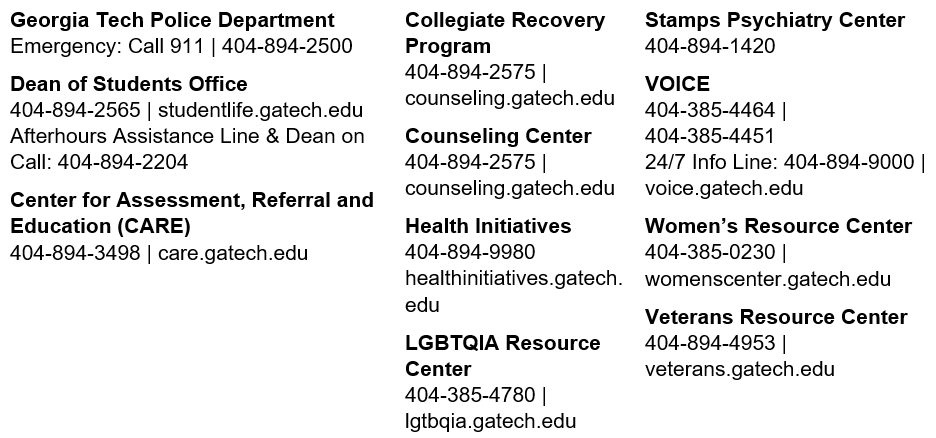
Community Resources
Project Details (36% of course grade)
The class project is meant for students to (1) gain experience implementing deep models and (2) try Deep Learning on problems that interest them. The amount of effort should be at least the level of 1.5 homework assignment per group member (2-4 people per group). The deliverables are
- Project Proposal (1%): Due Oct 7, 2026
- Milestone Written Report (10%): Due Nov 4, 2026
- Final Written Report (20%): Due Dec 4, 2026
- Poster Session (5%): Dec 7, 2026, Klaus Atrium
The final report is a PDF write-up describing the project in a self-contained manner will be the sole deliverable. Your final write-up is required to be between 6 - 8 pages using a standard Computer Science conference paper template such as CVPR and NeurIPS (we will release the LaTeX template). Please use this template so we can fairly judge all student projects without worrying about altered font sizes, margins, etc. After the class, we will post all the final reports online so that you can read about each others’ work. Additionally, we will allow people to upload additional code, videos, and other supplementary material as zip file similar to code upload for assignments. While the PDF may link to supplementary material, external documents, and code, such resources may or may not be used to evaluate the project. The final PDF should completely address all of the points in the rubric described below.
Rubric
We will release a detailed project rubric and the poster session format on Piazza soon.
FAQs
-
The class is full. Can I still get in?
Sorry. The course admins in CoC control this process. Please talk to them.
-
Unregistered Students who intend to register:
If you are not registered for this course, you will not have access to Gradescope for submission of HW0. Just use HW0 as a self-assessment until you manage to enroll in the course.
-
Registered students who are not able to access Gradescope:
This will happen if you were registered to the course very recently. Gradescope rosters are synced periodically and it may take some time for you to receive a Gradescope sign-up notification. If you still face problems with accessing Gradescope, please email us.
-
I am graduating this Fall and I need this class to complete my degree requirements. What should I do?
Talk to the advisor or graduate coordinator for your academic program. They are keeping track of your degree requirements and will work with you if you need a specific course.
-
Can I audit this class or take it pass/fail?
No. Due to the large demand for this class, we will not be allowing audits or pass/fail. Letter grades only. This is to make sure students who want to take the class for credit can.
-
I have a question. What is the best way to reach the course staff?
Registered students – your first point of contact is Piazza (so that other students may benefit from your questions and our answers). If you have a personal matter, create a private piazza post.
Related Classes / Online Resources
- CS231n Convolutional Neural Networks for Visual Recognition, Stanford
- Machine Learning, Oxford
- Deep Learning, New York University
- Deep Learning, CMU
- Deep Learning, University of Maryland
Book
Overviews
Note to people outside Georgia Tech
Feel free to use the slides and materials available online here. If you use our slides, an appropriate attribution is requested. Please email the instructor with any corrections or improvements.