Graduate Certificate in Cognitive Science

under the semester system.


Introduction

Cognitive Science is concerned with understanding intelligence, both natural and artificial, and developing tools that enhance intelligence. It is a multidisciplinary field with many loci of interdisciplinary interaction. It has conceptual and methodological roots in several disciplines and fields: artificial intelligence, psychology, philosophy, linguistics, intelligent systems, robotics, human-machine systems, anthropology, sociology, and neuroscience. At Georgia Tech, cognitive science faculty, students and researchers reside in Computing; Psychology; Industrial and Systems Engineering; Literature, Communications, and Culture; Public Policy; Architecture; Civil and Environmental Engineering; and Economics. One distinctive aspect of our program is the presence of several research programs that study cognitive science in the context of real-world problems. Our program provides students the diversity of methods and approaches necessary to study the range of phenomena involved in cognition and to apply their understanding of these phenomena in their area of study.

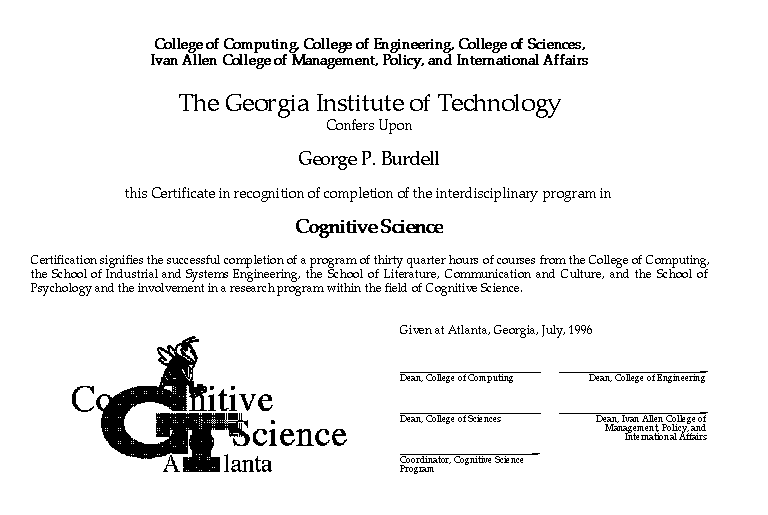
Graduate students who plan to approach their graduate training from a Cognitive Science perspective are encouraged to obtain a Certificate in Cognitive Science. Doing so provides an integrated set of courses and a peer group of other students interested in cognition from a variety of disciplines. The certificate can also be used to meet the Ph.D minor requirement.

Students receive their MS or PhD degrees in a home discipline at Georgia Tech while participating in an interdisciplinary curriculum tailored to their specific interests in Cognitive Science. Students from any unit on campus may receive a Certificate in Cognitive Science upon completion of the certificate requirements and their degree. Students enter the certificate program after first being admitted to a disciplinary MS or PhD program at Georgia Tech.

Cognitive Science Faculty

Logistics

Click here to retrieve the form used to petition for the certificate.

Requirements

To earn a certificate in Cognitive Science, students must fulfill graduate degree requirements in some unit on campus and, in addition, must take Introduction to Cognitive Science (3 semester hours) and 9 semester hours of courses from the courses listed below, for a total of 12 semester hours. In addition, students must participate regularly in the Colloquium in Cognitive Science as described below. The choice of courses must be approved in advance by a faculty committee consisting of the Cognitive Science education coordinator and three members of the Cognitive Science faculty from at least two different units; these would typically be the student's advisor and members of the student's committee. Courses not listed below may be substituted with approval of this faculty committee.

Courses

  • Cognitive Science core courses:

    • CS/Psych/ISyE 6795: Introduction to Cognitive Science (3 units; required). This is an introductory course with wide appeal, presenting multiple coherent perspectives on Cognitive Science. It is typically taken in a student's second or third quarter. It is taught by different instructors which rotate through the various disciplines involved in Cognitive Science, often team-taught or individually-taught with guest lectures, in a mixed lecture/discussion/problem-solving format.

    • CS/Psych/ISyE 8795: Colloquium in Cognitive Science (1 unit; required). This on-going seminar alternates weekly between a colloquium series and a brown bag series. Colloquia are typically presented by leading researchers in the field from all over the world, and include specific time for a student meeting with the speaker. Brown bags are informal discussions led by our own faculty and students. These usually focus on in-progress research and new directions. All Cognitive Science students are required to enroll in this seminar on an on-going basis, unless they are excused by the education coordinator due to an unavoidable conflict. In addition, one brown bag presentation of the student's research is required, and additional presentations are encouraged. Students from the various disciplines that comprise Cognitive Science but who are not specifically aiming for the Cognitive Science certificate are also encouraged to attend and participate.

Students must complete 9 units of courses (i.e., 3 courses) from the list below. The courses may be chosen from any category. It is normally expected that these courses will lie outside of the student's disciplinary area and that courses will be selected from at least two categories. The choice of courses must be appropriate to the student's educational program, and must be approved by a faculty committee consisting of the student's advisor, two additional members of the Cognitive Science faculty (including at least one faculty member from a unit other than the student's home unit), and the education coordinator. Students may substitute a course at another institution for one listed here with approval of this faculty committee.

  • Cognitive Science methods courses:
    • CS/Psych/ISyE 7790: Cognitive Modeling
    • Psy 6018: Principles of Research Design
    • Psy 6019: Statistical Analysis of Psychological Data I
    • Psy 6020: Statistical Analysis of Psychological Data II
    • Psy 7101: Methods in Engineering Psychology
    • ISyE 6401: Statistical Modeling and Design of Experiments
    • ISyE 7210: Real-Time Interactive Simulation

  • Disciplinary courses:
    • ISyE 6205: Cognitive Engineering
    • Psy 6011: Cognitive Psychology
    • CS 6610: Cognitive Systems
    • CS 7695: Philosophy of Cognition

  • Cognitive Science topical courses:
    • CS/PST 4752: Philosophical Issues in Computation
    • CS 7696: Cognitive Models of Science
    • Psy 6014: Sensation & Perception
    • Psy 6015: Developmental Psychology
    • Psy 7102: Engineering Psychology II: Displays, Controls, & Workspace Layout
    • Psy 7104: Psychomotor & Cognitive Skill Learning and Performance
    • Psy 7020: Survey of Cognitive Aging
    • Psy 8010: Seminar in Cognitive Psychology (topic to vary)
    • Psy 8020: Seminar in Cognitive Aging
    • Psy 8030: Seminar in Cognitive Neuropsychology
    • Psy 8060: Seminar in Quantitative Psychology
    • ISyE 6215: Models of Human-Machine Systems
    • ISyE 6231: Design of Human-Integrated Systems
    • ISyE 6232: Safety-Critical Real-Time Systems
    • ISyE 6223: Understanding and Supporting Human Decision Making
    • ISyE 6224: Topics in Human-Integrated Systems
    • ISyE 6232: Measurement and Evaluation of Human Interface Systems
    • LCC 6210: Studies in Culture and Communication
    • LCC 6213: Educational Applications of New Media
    • PUBP 6416: Critical Perspectives on Science and Technology
    • CS 4610: Knowledge Systems
    • CS 4630: Intelligent Robotics and Computer Vision
    • CS 4640: Machine Learning
    • CS 4650: Natural Language
    • CS 6450: Human-Computer Interaction
    • CS 6455: User Interface Design and Evaluation
    • CS 6460: Educational Technology: Design and Analysis
    • CS 6660: Intelligent Agents
    • CS 6670: Distributed Control Algorithms
    • CS 7020: Introduction to Cognitive Aging
    • CS 7495: Computer Vision
    • CS 7610: Modeling and Design
    • CS 7615: Knowledge Agents
    • CS 7620: Case-Based Reasoning
    • CS 7630: Autonomous Robotics
    • CS 7635: Computational Perception
    • CS 7640: Learning in Autonomous Agents
    • CS 7645: Numerical Machine Learning

  • Cognitive Science special topics: The faculty regularly offers relevant special topics courses and seminars, which may be counted towards the requirements for the certificate if approved by the student's committee as described earlier.
    • CS 8890: Special Topics in Cognitive Science
    • LCC 8801-6: Special Topics in Information Design and Technology
    • PST 4801-3: Special Topics in Philosophy, Science, and Technology
    • CS 8803: Special Topics in Computing

Additional guidance can be obtained from the
Cognitive Science education coordinator and the Cognitive Science faculty. Check with the offering departments and/or the education coordinator and/or the faculty for information about when courses are offered. Information on the Cognitive Science program is also available electronically from http://www.cc.gatech.edu/cogsci/.